Table of contents
If you've ever read a lawn-care bid and felt like the contractor was speaking another language, this glossary is for you. We use these terms in our own quotes; we'll define them the way they actually mean something in DuPage County, on the soils and grasses we work in every day.
Soil and turf basics
These show up on every visit and every bid.
Aerification (or core aeration)
A machine pulls 2–3 inch plugs out of the lawn at 4-inch intervals, leaving the cores on the surface. The plugs break down in 1–2 weeks and feed the soil. Aerification relieves compaction, lets water and fertilizer reach roots, and is the single highest-ROI service we sell. Cost in DuPage: $0.04–$0.07 per square foot, ~$160–$280 for a typical Aurora half-acre lot. Best timing: late August through mid-September.
Dethatching
Mechanical removal of thatch, the dead-grass mat that builds up between live grass and soil. A dethatcher uses tines to rake out the layer. Most DuPage lawns don't need this every year — only when thatch exceeds half an inch. Aerification handles thatch maintenance for most homes.
Topdressing
A thin (¼–½ inch) layer of compost or soil spread over the lawn after aerification. Improves soil tilth and feeds microbes. We charge $0.06–$0.10 per square foot when we do it; not every contractor offers it because it's labor-heavy.
Overseeding
Adding new seed to a thinning lawn. Best paired with aerification — the seeds drop into the cores and germinate in soil contact. Overseeding alone (without aerification) on a compacted DuPage lawn is half the value.
Tilth
Soil's physical structure — how easily it breaks apart and lets roots through. "Good tilth" reads as crumbly soil that breaks into clumps the size of corn kernels in your hand. Compacted clay (most of DuPage's east side) has bad tilth.
Grass species in DuPage County
Related service
Lawn Care
Mowing, edging, fertilization, and weed control on a weekly schedule. Same crew, same day, every week — April through November.
See the service →What's actually growing in your yard.
Kentucky bluegrass (KBG)
The default cool-season grass for DuPage. Soft underfoot, blue-green color, recovers from damage by spreading rhizomes. Needs 1.5–2 inches of water per week. Goes dormant brown in July if not irrigated.
Tall fescue
More heat- and drought-tolerant than KBG. Coarser blade, darker green. Doesn't spread by rhizomes (clumps grow upward), so it doesn't repair itself well; you'll overseed bare spots manually. Common in commercial properties for the lower water bill.
Perennial ryegrass
Fast germination (5–7 days). Used as a "nurse grass" mixed with KBG so the lawn looks established while the slower KBG fills in over 2–3 seasons. Doesn't survive harsh winters as the dominant species — it's a supporting role.
Zoysia
A warm-season grass we don't recommend for DuPage. It greens up in late May and goes dormant in October — half the year your lawn looks brown. Sold to homeowners as "low-maintenance"; for our climate, that's the wrong tradeoff.
Fertilization and treatments
Where the bid line items start to get expensive.
Pre-emergent
A weed-control product applied before crabgrass and other annual weeds germinate. Soil temperature is the trigger — apply when the soil hits 55°F, which in DuPage is mid-April most years. Miss the window and you're treating crabgrass instead of preventing it.
Post-emergent
Weed control applied after the weed is up. More expensive than pre-emergent and harder on the lawn. The first round is broad-leaf herbicide for dandelions and clover; a second round in early summer hits crabgrass that the pre-emergent missed.
Granular fertilizer
Slow-release pellets spread by a broadcast spreader. Releases nutrients over 6–12 weeks. Most DuPage programs run 4–5 granular applications per season — early spring, late spring, summer (low-nitrogen for heat tolerance), fall, and a final winterizer in October.
Liquid fertilizer
Spray-applied. Faster uptake (1–2 weeks of color response) but shorter duration. We use liquid for spot treatment and color rescue, granular for the program.
NPK ratio
The three numbers on every fertilizer bag — Nitrogen / Phosphorus / Potassium. A 24-0-12 bag is 24% N, 0% P, 12% K. Illinois banned phosphorus in residential lawn fertilizer (Lake-friendly law) — every legitimate bag at retail reads 0 in the middle. If you see a non-zero P number from a contractor, ask why.
Mowing and edging
The visit-to-visit work.
Cut height
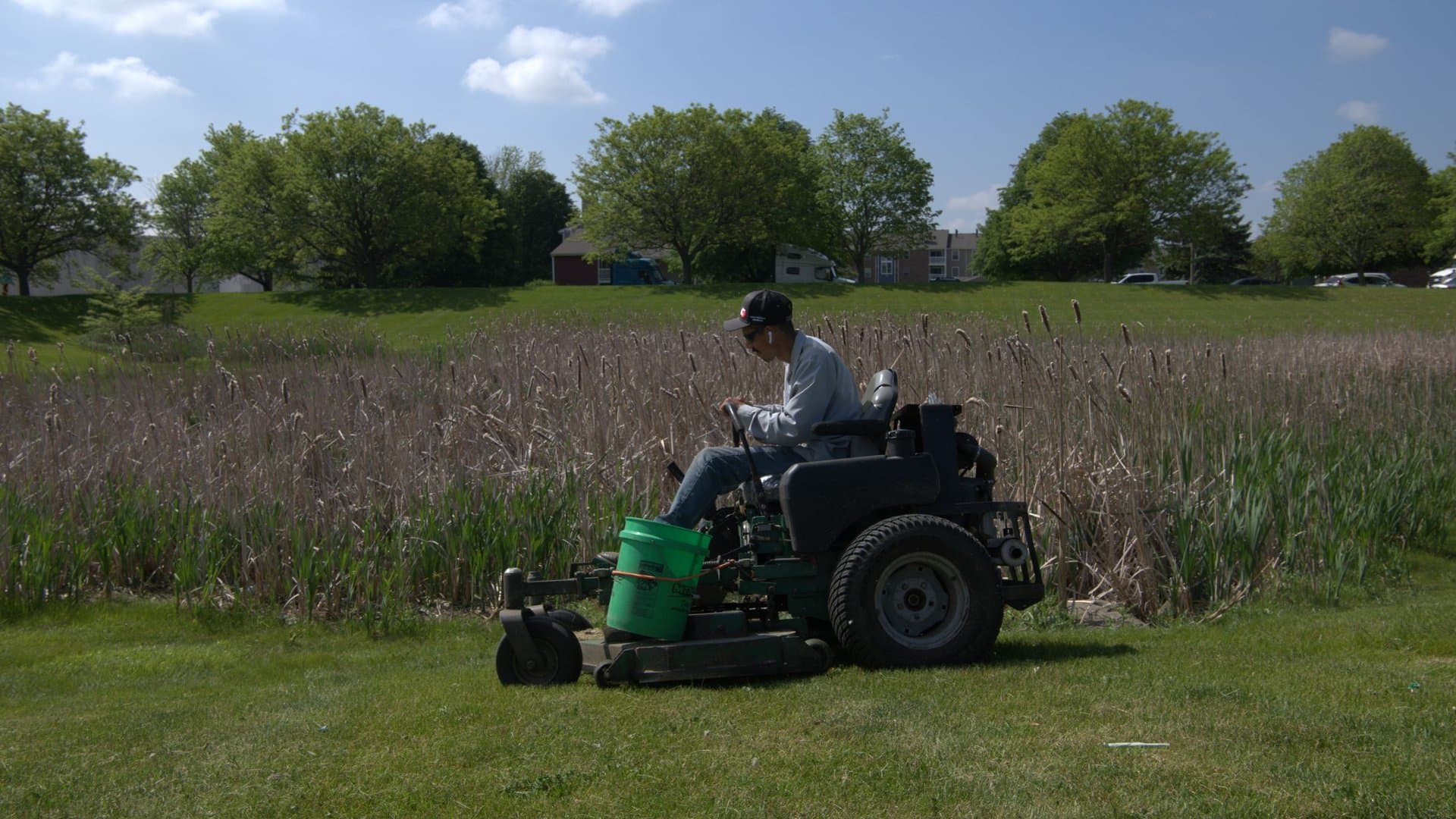
The blade-tip-to-soil distance. Cool-season grasses (KBG, fescue) want 3.0–3.5 inches in DuPage summer. Cutting shorter stresses the roots and invites crabgrass. We mow at 3.0 inches in spring and fall, 3.5 inches in summer.
Mulch mowing
Mowing with a mulch deck so the clippings drop back into the lawn. Returns about 25% of the lawn's nitrogen needs over the season. Free fertilizer; most programs don't offer it because the lawn looks "messier" for two days after each cut.
Edging vs. trimming
Edging cuts a clean vertical line where lawn meets driveway, sidewalk, or bed; uses a powered edger with a steel blade. Trimming uses a string trimmer to cut grass the mower can't reach (around fences, posts, trees). Most bids list both as one line; ask what your bid covers.
Cleanup
The blow-off. A two-stroke blower clears the driveway, walks, and patio of clippings after every cut. If the bid doesn't include cleanup, you'll find clippings in your house tracked in for a week.
What the bid should look like
After reading the glossary, run your last bid through this filter:
- Does it specify cut height (3.0 / 3.5)?
- Does it list the number of fertilizer rounds (4 vs. 5 vs. 6)?
- Does it call out aerification timing and lot size?
- Does it specify pre- vs. post-emergent and the soil-temperature trigger?
If three of the four are missing, the bid is selling you "lawn care" without telling you what's in the box.
We have a lot to say about each of these — but the short answer for most DuPage homes is: KBG/fescue blend, mowed at 3.0–3.5 inches, 4-round granular program with a pre-emergent, aerification + overseeding in late August. Anything fancier is upsell unless your soil tells you otherwise.