Table of contents
Pick the wrong patio material and you'll repour it inside ten years. Pick the right one and your kids will host their college graduation on it. The choice is rarely about taste — it's about three things: how cold your soil gets, how much you'll spend the second time, and what failure looks like when (not if) it happens.
Most DuPage homeowners walking into our showroom in Aurora have already seen concrete fail in their parents' yards. They've seen pavers buckled by tree roots. They want a straight answer about what to put down. Here's what we'd put down on our own properties — and why.
Concrete: the predictable workhorse
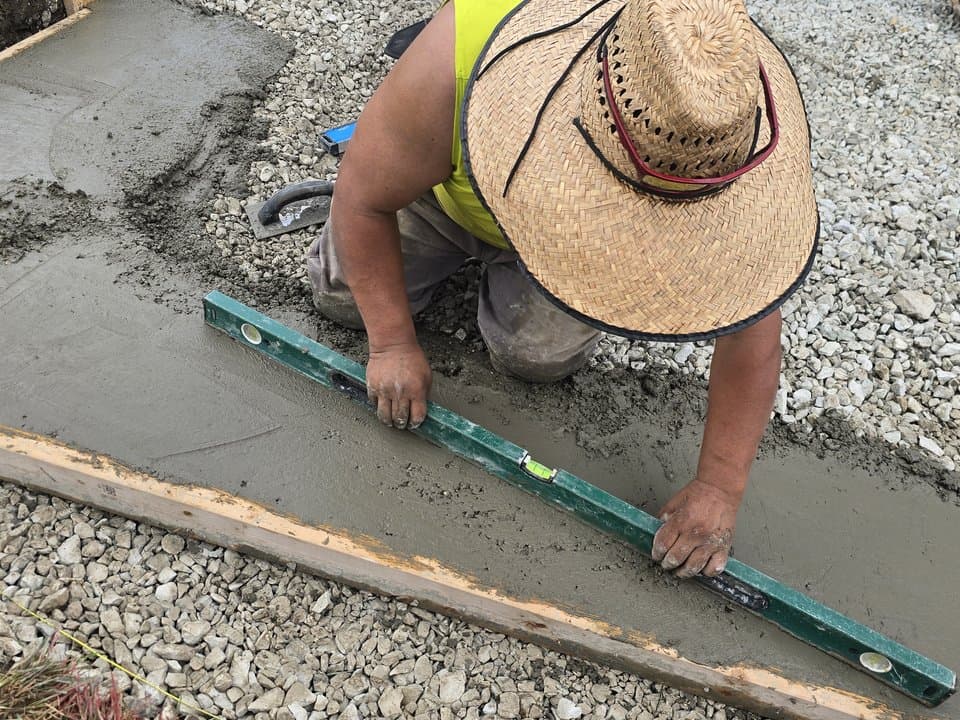
A 4-inch reinforced concrete slab is the cheapest way to roof a yard with a stone-like surface. It cures in 7 days, walks in 1, and lasts 25–30 years if it's installed over a 6-inch compacted CA-6 base. The base is rarely right.
Crews skip the base because it's invisible work — the homeowner sees the pour, not the compacted gravel underneath. So a yard that needs 6 inches of CA-6 gets 3 inches, and the slab cracks in winter three.
Spec
Where it should land
Cost (DuPage, 2026)
$12–$18 / sq ft
Lifespan
25–30 years if base is right
Freeze-thaw rating
Vulnerable above 1,000 sq ft
Repair cost
$4–$8 / sq ft (jackhammer + repour, color drift)
When to choose concrete
Choose it when budget is tight, the patio shape is rectangular, and you have less than 600 square feet to cover. We've poured 4-inch slabs in Aurora that look as good 12 years later as they did the day after we left. Those slabs all share three things: a 6-inch CA-6 base, control joints cut at 8-foot grids, and a fiber-reinforced mix.
[!tip] Ask for the base depth in writing. "6 inches CA-6 compacted" is the floor — anything less and you're buying a slab with a built-in expiration date.
Pavers: the maintenance-friendly upgrade
Related service
Patios & Walkways
Unilock-trained crew, no subcontracted base prep, and a 5-year installation warranty. Two decades of paver experience under one project lead.
See the service →Interlocking concrete pavers cost 1.6–2.0× concrete per square foot, but each unit can be lifted and reset if a tree root displaces it. That's the whole pitch. A paver patio that costs $24/sq ft to install costs about $2/sq ft to repair — concrete repair runs five to ten times that.
Unilock is the brand most DuPage hardscape crews put down because the freeze-thaw rating is honest. We're an authorized Unilock contractor; we'd say it either way.
Spec
Where it should land
Cost (DuPage, 2026)
$22–$32 / sq ft (Unilock Brussels Block, polymeric joints)
Lifespan
30–40 years; surface refreshable
Freeze-thaw rating
Excellent — joint-tolerant
Repair cost
$2–$4 / sq ft (lift, reset, refill polymeric sand)
Where pavers fail
Pavers fail at the edges. A paver field with a flush concrete edge restraint will outlast the homeowner; a paver field with no edge restraint will spread two inches every spring and trip somebody by year five. Ask whether the bid includes a poured edge or aluminum restraint — if it doesn't, walk.
Natural stone: the heirloom surface
Bluestone, limestone, and travertine are what we lay when the homeowner has decided this patio is the last patio. Cost lands at $36–$60/sq ft installed, and the finished surface reads as architecture, not landscaping.
Natural stone has the longest lifespan of the three (50+ years) and the lowest repair cost per square foot — but the highest replacement cost when a single piece chips. You can't color-match a 2026 bluestone slab to a 2014 one.
[!warning] Natural stone is not pet-friendly underfoot in summer. Bluestone hits 140°F in direct July sun in Naperville. Plan shade or a lighter-color limestone if dogs use the patio.
When natural stone makes sense
It makes sense over 600 square feet, on a property where the house architecture warrants the upgrade, and when the homeowner is OK with a phased build (some natural-stone yards take two seasons). It does not make sense as a budget compromise — the savings on the install never make up for the look of mid-tier flagstone next to a high-tier brick house.
Costs side-by-side
Here's what 600 square feet looks like across the three materials, installed by a crew that does it right:
Material
Total install (600 sq ft)
25-year cost (incl. 1 repair cycle)
Concrete slab
$7,200–$10,800
$9,000–$13,800
Interlocking pavers (Unilock)
$13,200–$19,200
$14,400–$21,600
Natural stone (bluestone)
$21,600–$36,000
$22,800–$38,400
The pavers row is where most of our hardscape work lands. The math is simple: 30% more upfront, 60% less in lifecycle cost.
Permits, and what nobody mentions
Every DuPage municipality treats hardscape differently. Naperville requires a permit for any surface over 200 sq ft. Aurora requires one over 100 sq ft. Wheaton triggers a permit if the surface drains toward a neighbor's lot. A reputable contractor pulls the permit; a cheap contractor talks you out of it.
We have a separate guide on hardscape permits in DuPage that walks you through the rules municipality-by-municipality.
The 10-minute test
If you're not sure which material you want, do this. Drive past three properties in your neighborhood that have patios you like. Knock on the door. Ask what the patio is, who installed it, and what's broken.
We do the same thing when we scout for material samples. The owners always tell you the truth — and the truth is that the right patio material is the one that's still beautiful at year 15. Most of them are pavers, in DuPage County, in 2026.